
 Schedule Your Visit
 Donate Now
 Tuition/Programs Payment
Schechter Shavua: December 19, 2025
Fifth Graders’ Milestone Schechter Moment: Reading Torah
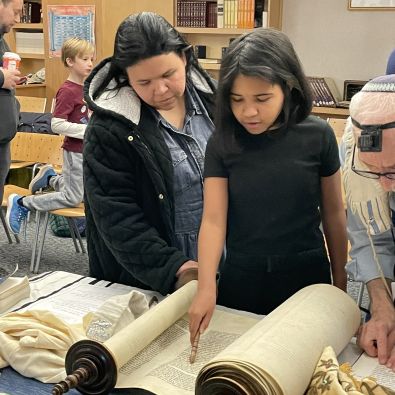 What stood out most at last week’s Fifth Grade Torah Reading program wasn’t only the poise and proficiency our students displayed as they read Torah for the very first time. What made the experience truly powerful was its authenticity—their demonstration of real, hard-earned skills.
While it’s certainly possible to memorize a short Torah reading, it’s something else entirely to learn the musical system well enough to teach it to yourself. That’s exactly what our fifth graders did. They devoted many hours with Rabbi Berger to mastering genuine Torah-reading skills: understanding the cantillation symbols, applying the grammar needed to pronounce and emphasize words correctly, and developing effective practice habits. These abilities prepare them not just for this moment, but for a lifetime of reading Torah.
Mazal tov to our Fifth Grade students and their families on their joyful and inspiring achievement!
Click HERE to see more photos of our fantastic Fifth Grade Torah readers!
Kindergarten Families Share a Havdalah Experience
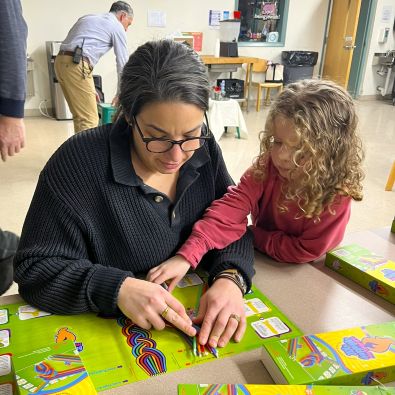 On a quiet Saturday night, theIlanot (Kindergarten) students and their grown-ups came together to celebrate our 5th annual Havdalah night. Students have worked for the past three months learning what Havdalah is, why it takes place on Saturday evenings, and all of the blessings that are part of the service. Rabbi Berger joins the Ilanot class every Monday morning to start their week with Havdalah, and the students excitedly shared all that knowledge with their parents.
This special Ilanot Havdalah Program is a chance for everyone to celebrate Havdalah together. Students and parents worked together to make a special Havdalah set to take home and use for all the Saturday nights to come!
Click HERE to see more photos!
Lev Tov in Action: Schechter Students Give with Heart
 The act of giving back to those in need is woven into the very fabric of Schechter’s core values of Good Heart (Lev Tov) and Community (Kehillah). Each year, students contribute in a meaningful way on Giving Tuesday, from the two-year-olds through the 8th graders.
Students supported Dignity Grows by packing 1500 tote bags filled with hygiene products for our neighbors in need. They decorated, then assembled, bags of packaged snacks that can be given out to families at the Klingberg Center; they also collected donations of both new and gently used clothing, then sorted them by size for the Klingberg Center. Lastly, they prepared "fidget boxes" -- little kits with all different fidget toys -- that provide a sensory outlet for repetitive movements, helping to improve focus, relieve stress, and manage anxiety.
Schechter’s impact of giving reaches beyond our current students! When Ruth Weiner, Schechter’s first principal and a former Schechter parent, read about our collection drives, she made a fantastic shiddach(match): her son, Ethan, now retired, is passionate about making beautiful fidget toys with his 3D printer. These colorful toys, complete with moving parts, are then donated to charities that help children. We are thrilled to share these along with the other student contributions!
Click HERE to see photos of Schechter's Giving Tuesday action
Shabbat Hanukkah/Parashat Mikketz
 Our parashahbegins with Joseph in prison while Pharoah dreams of scrawny cows and parched wheat—a vision of the years of plenty and famine that will strike Egypt. It ends with Joseph’s older brothers groveling before him in Pharaoh’s palace after he sentences his younger brother Benjamin to jail for life. It’s a huge dramatic arc! Over the course of the story, Joseph rises to power, and his brothers transform from jealous tormentors to chastened, repentant men.
But we may wonder: why did it take so long for Joseph to reunite with his family? According to the story, Joseph ruled in Pharaoh’s house for at least eight years before his brothers showed up in Egypt seeking to buy food. Why did he never send word to his father that he was still alive during those eight years? He was no longer a defenseless younger brother; with his power, he was in no danger, and even had the ability to punish his brothers’ punishment if he wanted. Instead, he only reveals himself to them, and arranges for a reunion with his father, after Judah begs for Benjamin’s release from jail. Why the long wait? Didn’t he miss his father?
Aviva Zornberg, in her classic book Genesis: The Beginning of Desire, points out that Joseph only learns about the trick his brothers played with his bloodied coat when his brother Judah begs for Benjamin’s release. Until that point, says Zornberg, Joseph must have been wondering, “Why hasn’t my father come down to Egypt to buy me back and save me?!” All along, Joseph thought his father had abandoned him! Only when Judah tells him that Jacob had been tricked does Joseph understand why his father never searched for him—because his father thought he was dead. Only then does Joseph reveal himself.
Our lives may not be quite as dramatic as Joseph’s. Nevertheless, we frequently find ourselves in a similar position—feeling like we have been abandoned, that someone we care about has forgotten us. In response, we close ourselves off. We let the relationship languish, mistakenly thinking that the other has cut off ties. Hanukkah, like all holidays, can bring these rifts to the foreground.
But the lesson of our parashah is that perhaps—just as Jacob never forgot Joseph, but didn’t know how to reach him—our friend is grieving all the while at the loss of our companionship, unaware that reconciliation could happen in an instant with one outstretched hand! May Parashat Mikketz , and Hanukkah, lead us to overcome those assumptions, reach out to others, and find peace.
Shabbat Shalom and Happy Hanukkah,
Rabbi Jonathan Berger
Head of School
Questions for the Shabbat table:
- During those eight years when Joseph was serving as Pharaoh’s second-in-command, still estranged from his family, he surely felt a mix of emotions. Which do you think were more prominent?
- Joseph was clearly tempted to take revenge on his brothers. What do you think kept him from doing so?




CONNECT & FOLLOW US



© Solomon Schechter Day School of Greater Hartford | Site design Knowles Kreative