
 Schedule Your Visit
 Donate Now
 Tuition/Programs Payment
Schechter Shavua: February 13, 2026
“Fur Real” Science: What Monsters Teach about Genetics
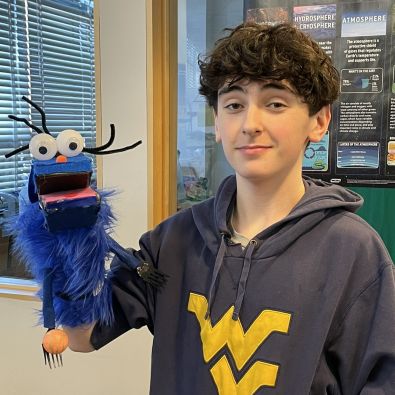 In the Torah (Genesis 30), Jacob "gets Lavan's goat" with some breeding "magic" that causes Jacob's speckled flock to grow while Lavan's flock of black goats do not. How does this Torah lesson lead to an entire science unit? Middle schoolers learning about genetics dove into the concepts of Dominant (speckled) vs. Recessive (black), Homozygous/Heterozygous, Phenotype/Genotype, and more. Always on the lookout for ways to make science come alive, teacher Laurie Stanfield challenged her students to "breed" Sesame Street monsters as a way of learning genetics.
Students "bred" a couple of puppet generations on paper, testing out the kinds of characteristics they felt would be dominant or recessive. Students then took their Punnett Squares and other genetic calculations to the Makerspace in order to build their Muppet "grandchild!” Most found that creating the prototypes was the hardest part, but they persevered to create their own unique "grand-monsters!" Last week, at the Muppets Science Extravaganza, they explained to parents and other guests the genetics behind each puppet’s appearance. Favorite genetic features to adjust included fur color, overall furriness, and type of hair; many of the muppet grandchildren featured dominant googly eyes!
To complete the genetics unit, students discussed "change over time" and natural selection. Each student camouflaged their own paper butterflies to demonstrate the power of blending in for an insect’s survival. They also performed "bird beak battles" to see how different sized and shaped beaks might affect survival.
During our after school Robotics program, we first learned a bit about how the Ozobots worked, and we were able to build racetracks and paths for the Ozobots to navigate. Now we are learning about block coding our own character to move on demand in Scratch Jr!
Click HEREto see lots of fun Muppet creations!
Powering the Learning: Exploring Energy though Motion
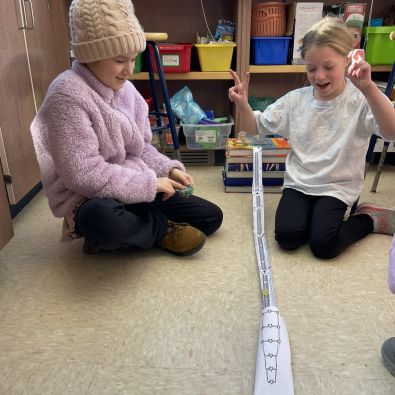 The Alim students (gr. 3–4) have been buzzing with excitement as they dive into their science unit on energy! In this hands-on unit, students are investigating how energy is stored, how it makes objects move, and how energy is transferred during collisions.
So far, students have completed two engaging experiments. First, they designed and built Twist-o-matic testers—paper models inspired by amusement park rides. By twisting rubber bands and letting them go, students discovered how energy can be stored and released to create motion.
Next, students took on the challenge of building bumper coasters, sending marbles racing down steep tracks. This experiment helped them see how height gives objects energy and how that energy transfers as marbles collide and move along the track. These hands-on activities sparked curiosity and gave students a memorable way to explore big science.
Anafim Lessons Start Small Before Becoming Explosive!
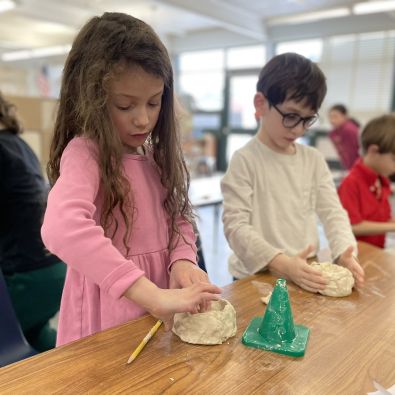 Anafim students (gr. 1-2) recently hunched over their desks, molding balls of clay into the form of tiny volcanoes. The students concentrated as they pinched and smoothed. These mini-volcanoes are precursors to a large-scale volcano project that Anafim will collaborate upon later this year. They began by creating mini volcanoes as part of the Mi Ani program: students were given materials and were encouraged to jump into creating their own small volcano through trial and error.
As they worked, students thought out loud: “I think we already failed. We should’ve used water for the clay.” The knowledge gained through trial and error was valuable. One said, “I don’t think your volcano is large enough. There's no space for the ingredients that will make it explode.” Another student noticed, “Look, if you take a pencil and turn it on its side, you can make smooth edges!”
After they test their volcanoes next week, the students will reflect together on what went well, what didn’t go as planned, and what can be improved. This learning will guide students and set them up for success as they prepare to construct a large-scale volcano as a class later this year.
Click HERE to view more photos
Creating Games Helps Bring Science Concepts to Life
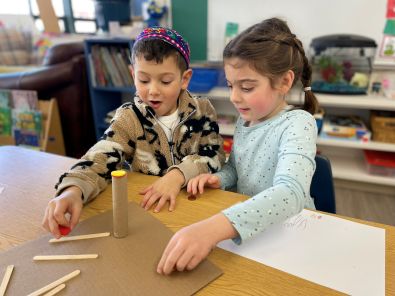 TheIlanot (Kindergarten) students turned curiosity into discovery as they explored what happens when objects collide. They began by experimenting with small plastic discs—bumping them into one another, sliding them into cardboard tubes, and testing what happens when they hit walls made of popsicle sticks. Each bump sparked new questions and observations.
Using what they learned, students teamed up to design their own simple “bumping games.” They discussed materials, sketched plans, and brought their ideas to life—testing, adjusting the rules, and improving as they went. Along the way, they practiced collaboration, problem-solving, and creative thinking.
This hands-on introduction to basic physics concepts proved that some of the best learning happens when ideas (and objects!) collide.
Click HERE to view more photos
Parashat Mishpatim: Engaging with the Torah through STEAM
Sarah Montag, Director of Teaching and Learning
 Parashat Mishpatim comes immediately after the drama of Mount Sinai. After the thunder and revelation of the Ten Commandments, the Torah shifts into something quieter but deeply important: the laws that guide everyday life. Mishpatim teaches that holiness is not only found in extraordinary moments, but also in the way we build communities, treat one another fairly, and take responsibility for the world we shape.
At Solomon Schechter Day School, our commitment to STEAM (Science, Technology, Engineering, Arts, and Mathematics) education reflects this same Jewish vision. Through hands-on learning in robotics, MakerSpace, Mad Science extracurriculars, and rich in-class science units—exploring genetics, volcanoes, energy, and physics to name a few—students learn that creativity and innovation are not separate from Jewish values. Instead, they are a way of living them out.
One of the central messages of Mishpatim is that knowledge must lead to action. The Torah does not stop at abstract ideals; it provides concrete steps for building a just society. Similarly, STEAM learning moves students beyond simply absorbing information. In our classrooms and labs, students become engineers, scientists, designers, and problem-solvers. They test hypotheses, build prototypes, collaborate with peers, and revise their work through persistence and reflection.
This process echoes the Torah’s emphasis on responsibility. Mishpatim includes laws about safety, damages, and accountability—teaching that when we create something, we must also think about its impact. In MakerSpace challenges, students learn that building is not only about imagination, but also about planning carefully, learning from mistakes, and considering how their designs affect others. Whether constructing a tower, programming a robot, or experimenting with chemical reactions, students are practicing the ethical mindset Mishpatim demands: to create thoughtfully and with care.
Our science units also align beautifully with the Torah’s belief that the natural world is full of wonder and meaning. Studying genetics invites students to explore the complexity of life and inheritance, and to make it more interesting and appealing, we take a look at Muppet and Monster inheritance, while units on volcanoes and energy help them understand the forces that shape our planet. Physics teaches students about motion, balance, and unseen systems that hold the world together. These investigations inspire awe—an essential Jewish response to creation.
Extracurricular STEAM opportunities further extend this learning. In Mad Science, students engage in exciting experiments that spark curiosity and joy. In robotics, they practice sequencing, problem-solving, and teamwork as they bring their ideas to life through technology. In every setting, students learn that innovation is a form of exploration—and that learning is an active, ongoing journey.
Mishpatim reminds us that Torah is meant to be lived, not only studied. At Schechter, STEAM education helps students do exactly that: apply knowledge, act with responsibility, and approach the world with curiosity and purpose. By combining Jewish values with scientific inquiry and creative design, we empower our students to become builders of a future rooted in both wisdom and wonder.

CONNECT & FOLLOW US


© Solomon Schechter Day School of Greater Hartford | Site design Knowles Kreative