
 Schedule Your Visit
 Donate Now
 Tuition/Programs Payment
Schechter Shavua: May 8, 2026
Igniting Inquiry: How Tough Jewish Questions Build a Better Jewish Future
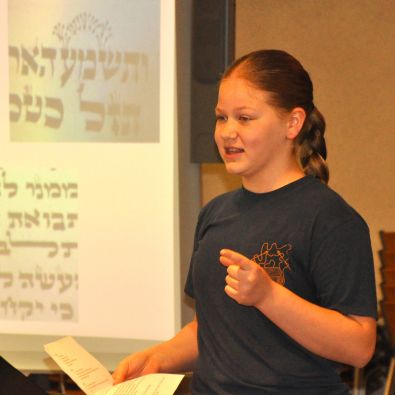 “Why are some animals kosher while others aren’t?” “If electricity wasn’t around at the time of the Torah (or Talmud), why do some people think that the Torah prohibits it on Shabbat?” “Was Noah really a tzadik (righteous one)?” These questions, and other equally powerful ones, were posed by our seventh graders—and through research, guided by local experts, they worked to develop answers! In Rabbi Chatinover’s Judaic Studies class, the Perahim students started with a long list of possible questions, and honed in on the one that spoke most to them. Local rabbis, educators, and professors shared some expert knowledge, and helped them to study some primary sources—Torah, Talmud, Shulhan Arukh, and more. They developed presentations to share what they learned. Our core value of Chochmah talks about how gaining wisdom comes through posing complex questions, exploring multiple perspectives, grappling with original texts and primary sources, and discovering personal meaning; our 7th graders certainly brought Chochmah to life through their research and presentations!
Ask a Schechter 7th grader about:
- Why do Jews bury their loved ones within 24 hours of their passing?
- What makes a Torah kosher?
- What are the rules (guidelines?) of Modesty?
- Tropes: where do they come from? And why are there different tropes?
- Why are there different types of fast days?
- Was Noah really a tzadik (righteous one)?
- Who are the different kinds of Jews?
- If electricity didn’t exist at the time of the Torah (or Talmud), why do some people think that the Torah prohibits it on Shabbat and certain holidays?
- What are the different laws of Kashrut?
Click HEREto read more about 7th grade's Tough Jewish Questions!
ArtReachMishkan: Exploring Identity Through Art and Hebrew
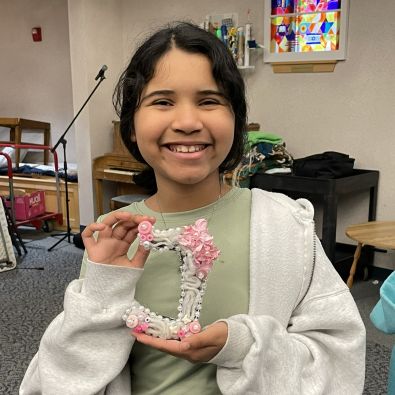 We are proud to share the successful completion of ArtReachMishkan, a special collaboration with the Mishkan Museum of Art in Kibbutz Ein Harod, made possible by the generous support of the Jewish Federation. This unique program helped strengthen our students’ connection to their Jewish identity and Hebrew language through the exploration of Israeli art and history.
Throughout the program, students participated in virtual tours of the museum’s renowned collection, learning about Kibbutz life and the diversity of Jewish heritage. They also created original artwork inspired by the first letter of their Hebrew names, expressing their individuality and personal identity.
The project concluded with a celebratory Zoom session, where students proudly presented their work and explored traditional Judaica. We are grateful to Hadar and Ortal for leading this initiative, and to our art teacher, Candela, for her guidance and support.
Threads of Tradition: Sixth Graders Create Their Own Tallitot
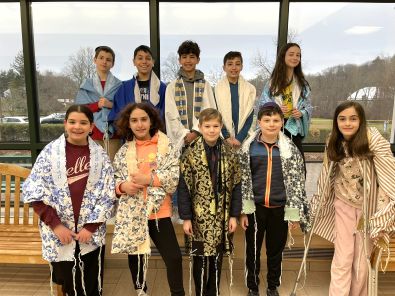 If you were to visit Schechter during Middle School tefillah (prayers), you would see students draped in a magnificent array of colorful fabrics. One of the time-honored Schechter milestones takes place in Middle School, when sixth graders design and create their own personalized tallitot that they use for school tefillah . Students select a fabric they like, and have it sewn to the dimensions of a tallit . Then, with the help of Schechter alumni parent and local artist Elizabeth Ehrlich, they design, print, and add the atarah (the wording along the tallit’s neckband). Meanwhile, in Judaic Studies class, the sixth graders study the passage from the Torah that commands us to make the tzitzit (the tassels on the corners of a tallit ), and discover the meaning of their original azure color and of the tzitzitthemselves.
Finally, students and parents gathered together in person for the Tallit Program, when their personalized tallitot would be finished and ready to wear. After a joint text study, each family carefully tied the tzitzit to the student's tallit . And then, the closing and very meaningful moment came when, together, they recited the shehehiyanuprayer.
It was very exciting to see the parents and students study together and keep the mitzvah of making a tallit. Both the evening and the tallit itself are pieces of Schechter that stick with families long into adulthood.
Click HERE to view photos!

Parashat Behar-Behukotai—The Paralysis of Fear
 Franklin Roosevelt may have been guilty of exaggeration when he said, in his first inaugural address, that “The only thing we have to fear is fear itself.” The only thing? At the time of his speech, millions of families were understandably afraid of starvation and homelessness. Black Americans, especially in the South, experienced lynchings, violence, and other byproducts of racist hatred. By March of 1933, Hitler had assumed power in Germany. There were many things to fear besides fear itself.
And yet Roosevelt was right. As he proceeded to say, “nameless, unreasoning, unjustified terror which paralyzes needed efforts to convert retreat into advance” is worse than any other threat. Actual dangers can be dealt with. People can support each other in hard times; communities can stand together against hatred; nations can unite their forces against evil dictators. Fear, however, paralyzes; it robs us of our ability to do what is best in any given situation. If we trust in ourselves and our communities, then no other threat need scare us—we just have to tackle the source of our fear. “Unjustified terror,” however, admits no direct response.
That is why, in our parashah , panic is the worst of God’s punishments. This week’s parashahlists a series of horrific punishments that would befall the Israelites should they break faith with God: attacks by warlike enemies, rampant vicious beasts, famine, general destruction. But the list doesn’t end there; the worst is saved for last:
As for those of you who survive, I will cast a faintness into their hearts in the land of their enemies. The sound of a driven leaf shall put them to flight. Fleeing as though from the sword, they shall fall though none pursues. With no one pursuing, they shall stumble over one another as before the sword. (Lev. 26:36-37, NJPS translation)
This is the ultimate calamity—that we become a people so scared that the sound of a leaf paralyzes us with fear, and leaves us unable to stand. “The only thing we (would) have to fear is fear itself”—but that fear could topple us. What do we do in times like these—how do we respond to the sound of the driven leaf? Our parashah offers only one answer: teshuvah.
In the Torah’s context, this makes sense: the troubles we suffer are God’s punishments, and if we return to God, the punishments will end. But how are we to see teshuvah as a solution to our problems? What can religion do in the face of our difficulties?
Judaism helps us remember what is truly important. The prayers we say, the Torah we study, and the mitzvotwe perform—all constantly remind us to be grateful for our family, our capacity to do good, our love of fellow human beings, and the amazing natural world in which we live. The Torah’s message for us is that in trying times, when the sound of a driven leaf makes us tense, we need to appreciate each and every one of our blessings.
We will surely be able to handle each of the concrete challenges that face us today. What of the blurrier fears? Teshuvahcan reassure us by helping us to focus on the miracles that surround us every day. May we find strength, and peace, through the values of the Torah and the relationship we forge with God.
Shabbat shalom.
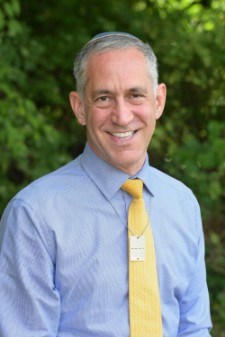
Rabbi Jonathan Berger
Head of School
Questions for the Shabbat table:
1. There are many possible metaphors for things that trigger needless panic. Why might the Torah have chosen “a driven leaf” as the symbol of a source of fear?
2. Is there a Jewish practice that brings you comfort when you are unsettled?


CONNECT & FOLLOW US



© Solomon Schechter Day School of Greater Hartford | Site design Knowles Kreative