
 Schedule Your Visit
 Donate Now
 Tuition/Programs Payment
Schechter Shavua: February 27, 2026
Sound, Story, and Self-Expression through Music
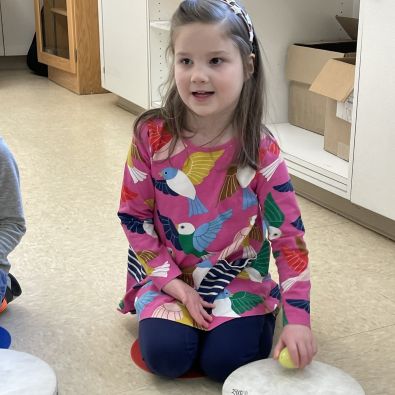 In Mrs. P’s music classes, students build strong foundations as young musicians by learning to read, write, and perform music in engaging, hands-on ways. Through classroom songs and activities, students explore rhythm, melody, and musical symbols - decoding solfège (Do-Re-Mi-Fa-Sol-La-Ti) and rhythmic patterns while beginning to create and perform their own musical ideas with instruments and classmates.
Students also practice how to listen actively and respond creatively. Using scarves, parachutes, flashlights, and balls (and, of course, percussion instruments), students explore steady beat, rhythm, and musical form in ways that get their whole bodies involved. Ms. P keeps students engaged from start to finish: in a favorite Shorashim (EC3-4) activity, students pointed flashlights at fun posters as they trained their voices into ascending and descending tones, and even tones that moved their voices like roller coasters!
Beyond general music classes, Mrs. P leads two dynamic Middle School electives: Broadway Dance and Acting Games. Broadway Dance students are finishing up the choreography to Footloose! This high - energy piece has given students a chance to learn some new steps, work together as a team, and even create moves of their own. In addition, they have been comparing and contrasting the choreography styles of some of their favorite on-screen Broadway hits, from Wicked to Hamilton and more. Through this process, students learn that “choreography” is much more than just dance -- it is an essential element to storytelling that can make or break a show! In Acting Games elective, students participate in quick-thinking, imaginative activities that strengthen their performance skills and encourage them to step outside their comfort zones. Recently, small groups collaborated on creating short skits from intentionally vague scripts. By reading between the lines, students developed original plots and characters that reflected their unique perspectives, transforming simple scripts into lively, meaningful performances.
Music classes and electives are full of movement, creativity, and collaboration, helping Schechter students understand, experience, and enjoy music together!
Heating Things Up in PE—Even in Winter!
 Even in the chilliest months of the year, there’s plenty of energy and excitement warming up our Physical Education classes!
In the Lower School, students are strengthening both their bodies and their brains. As part of their physical wellness studies, they’ve been mastering the 13 major muscle groups in a creative and engaging way... through a lively game of hangman! This interactive challenge helps students learn the names, correct spelling, and locations of key muscles, building a strong foundation of knowledge they can carry into future fitness activities.
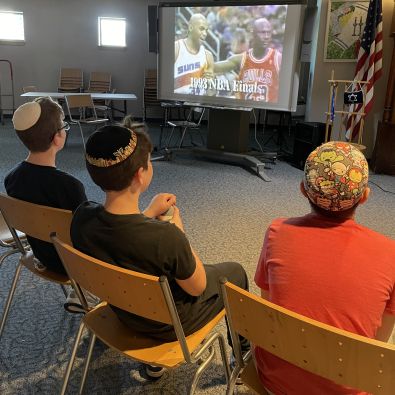
Middle School students are focusing on volleyball fundamentals including striking, passing, positioning, and practicing a variety of serves. Beyond skill development, students are learning that teamwork, collaboration, and a positive attitude are just as important as technique. Once they feel confident in their abilities, they put their skills to the test in friendly matches. As spring approaches, they’ll head outdoors to sharpen their flag football skills and continue building athletic versatility. Students enrolled in the Middle School basketball elective are combining athletics with analysis. By watching basketball documentaries, they explore the stories and strategies of influential players and teams, gaining insight into the game’s evolution and tactics. They then bring that knowledge to life during scrimmages, applying what they’ve learned in real time on the court.
Meanwhile, our Early Childhoodstudents always look forward to PE with Coach! A highlight of their class is the ever-popular obstacle course. This favorite activity encourages our youngest learners to build confidence while developing speed, balance, and agility through joyful movement and play.
From muscle mastery to match play, our students continue to grow stronger, more skilled, and more confident with every season.
From Masks to Masterpieces: A Season of Creativity in Art Class
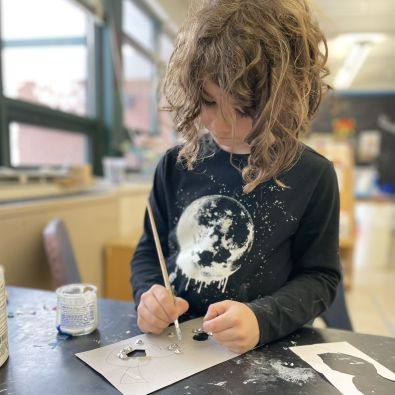 In art class, students are preparing to celebrate Purim! Through different activities such as decorating masks and creating colorful crowns, they are using a variety of materials, colors, and textures to express their imagination and personality. At the same time, students are delving into the meaning of Purim as they work collaboratively and celebrate community.
Students in the Middle School art elective are exploring major art movements by reimagining a single object in multiple styles. The project began with a detailed observational drawing, helping students focus on proportion and realism. They then transformed that same object through movements such as Cubism and Pointillism, experimenting with geometric forms inspired by Pablo Picasso and the careful dot technique associated with Georges Seurat. They similarly experimented with Pop Art and Abstract versions of their art. Through this process, students are discovering how different artistic styles can dramatically change the way we see and interpret the same subject.
Parashat Tetzaveh—Couture, Uniforms, and Our Own Taste of Each
 Consider two elite types of fashion: (1) custom couture, the kind of clothing you might see celebrities wearing to the Met Gala, and (2) an actual sports uniform that you only get to wear if you actually make a team. Couture is meant to be unique, tailored to an individual, pushing boundaries, displaying as much individuality as possible. Uniforms are the opposite: they depersonalize, subsuming an individual into a larger group or class, elevating someone by showing that they aren’tunique.
And as regular human beings, we all have different ways to sample that elite status. The Balenciaga gown that Nicole Kidman wore on the red carpet? You might never have the chance to wear that exact one, but you might find a similar version available for sale in a nice story—and when you put it on, you’d feel a special thrill. And while you may never make a D1 or major league team, so you’ll never get the chance to wear a University of Michigan uniform for real (to use an example close to my heart), you can buy an authentic, licensed jersey—and when you put it on, you’d imagine having a special connection to those athletes who wear it because they earned it.
When I read this week’s parashah , which describes the clothing of the kohen gadol /high priest, I can’t help but think about custom couture and special uniforms. On the one hand, the kohen gadol’s clothing was unquestionably unique and fancy. Materials included gold and silver, a bejeweled breastplate, and brilliantly colored fabrics. No one else in ancient Israel wore anything remotely comparable. But on the other hand, it elevated the wearer by highlighting the role that he played, not by showcasing anything individual about him.
The most precious part of his uniform was probably not the jeweled breastplate or even the gold accessories—it was the deep blue/tekhelet tunic. Tekheletwas a special ancient dye, indigo in color, but produced from the gland of a small sea snail. It was incredibly expensive, because each snail produced only a small amount of dye, and the processing was complicated. To dye an entire tunic with that color would have been well beyond the means of most Israelites. Even a scarf-like garment would have been prohibitive!
But later in the Torah, when we are commanded to tie fringes (tzitzit ) to our four cornered garments, we are told to include a single thread of tekhelet . And note: while the tradition developed that only men were required to wear tzitzit, the Torah itself makes no such distinction; all Israelites were to have that special thread! In that way, we were all meant to wear a reference to the elite clothing that was both couture and a uniform. Everyone got to feel special, sacred, and connected to something higher.
For complicated reasons, most of us no longer wear even white tzitzit regularly, let alone tekhelet versions (though it is available!). We may have some particular outfits or accessories that we wear on special occasions—but I’m not sure anything quite matches the way that donning clothing with a tekhelet thread might have made the Israelites feel. Still, when we hear this week’s parashahread, I hope we can capture that feeling of connection, of belonging, of being elevated!
Shabbat shalom,
Rabbi Jonathan Berger
Head of School
Question for the Shabbat table:
What’s the finest/most special set of clothes you’ve worn? How did it make you feel when you put them on?



CONNECT & FOLLOW US



© Solomon Schechter Day School of Greater Hartford | Site design Knowles Kreative