
 Schedule Your Visit
 Donate Now
 Tuition/Programs Payment
Schechter Shavua: January 30, 2026
Snowy Science in Shorashim
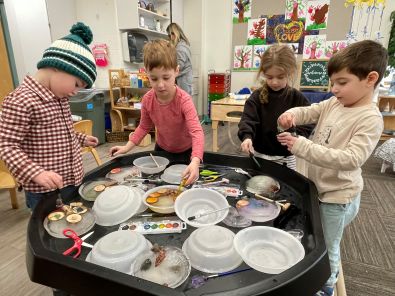 Learning develops best through exploration and trial/error! The Shorashim students (EC3-4)have been immersed in winter-themed science projects that help teach broader scientific concepts while piquing their curiosity! These are just a few of their recent science activities:
- Magnet Art: equipped with a magnet, a paper clip, and white paint, students pretended to go ice skating by using the magnet to drag their paperclip through the paint. They learned about the way that magnetic north and south poles repel or attract each other while creating fun winter art!
- Snow dough: students squish and mushing dough made from a mixture of oil, water, and flour. It’s fun for all, especially students who are kinesthetic learners!
- Snowflake art: following a discussion about the water cycle of snowflakes and how every snowflake looks different, students created their own snowflakes using a mixture of salt and water!
- Salty reactions: students observe in their classroom science lab the effect of salt on chunks of ice. They compared that slow melting to what happens when they take a hammer to a chunk of ice, an activity that works students’ fine motor skills as well!
- Bubbly fun: using baking soda and vinegar, students explore the textures and sounds made by that chemical reaction (clue: more vinegar makes the baking soda become more bubbly!). Students feel different textures and smells created by these reactions.
- Investigating ice: each student placed five items into a bowl with water, then left it outside to see what happened. Using droppers filled with paint, they bathed the ice in color. Max asked his friends, “do you want to see if we can make orange ice from yellow and red dye?” Other students tested how quickly they could melt the ice.
Click HEREto see more photos of snowy science!
Dramatic Play in Action: Our Hair Salon & Barber Shop
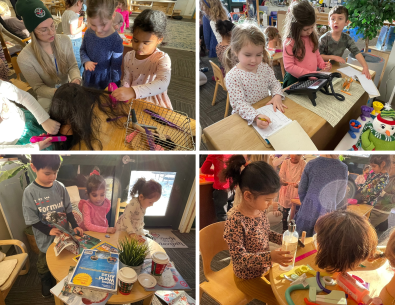 The Shorashim Alef (EC3-4) dramatic play area has transformed into a lively hair salon and barber shop, inspired by the children’s growing interest in doing their own hair and styling their friends’ hair while looking in the mirror. Their curiosity and creativity guided this experience, allowing teachers Julie and Jessica to turn this interest into a rich and meaningful learning opportunity. For a special treat, the class had a visit from a professional hair stylist, Schechter parent Kelly Neumann!
Students explored braiding, curling, washing, cutting, shampooing, and even coloring hair through imaginative role play. They also practiced sorting and organizing salon and barber tools, strengthening early math and problem-solving skills. To make the experience even more realistic, they created a waiting area complete with cell phones, magazines, Starbucks cups, and gift cards to “pay” for coffee and tea. This added layer of pretend play encouraged communication, creativity, and real-life connections.
Through this dramatic play experience, our friends practiced turn-taking, cooperation, and learning from one another, while building confidence, social skills, and strong relationships. Best of all, they were fully engaged in joyful, hands-on learning rooted in real-world experiences. What a fun, enriching, and stylish learning adventure for our friends!
Growing Good Hearts from the Very Start
 In addition to guiding our youngest students as learners, Schechter is deeply committed to nurturing our Core Values at every developmental stage. Even our earliest learners explore big ideas like Lev Tov (Good Heart) and Kehillah(Community) through stories, thoughtful discussions, and hands-on activities that bring these values to life in meaningful, age-appropriate ways.
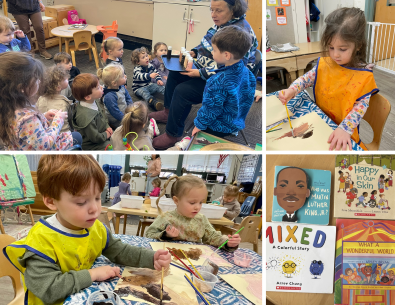
Rather than closing school on Martin Luther King, Jr. Day, our students spend the day learning about Dr. King’s powerful lessons of kindness, fairness, and standing up for others. In Nitzanim (EC2), students read several stories about Dr. King’s life that introduce who he was, what life was like for Black Americans during his childhood, and the important changes he worked tirelessly to create.
Classes also enjoyed Happy in Our Skin by Fran Manushkin, a joyful story celebrating the beauty of different skin colors and what makes each of us unique. Another favorite was Mixedby Arree Chung, where the three primary colors discover that when they come together, their world becomes richer, more interesting, and more fun—just like our own community.
By emphasizing these values at such a young age, we help lay a strong foundation of kindness, empathy, and respect—lessons our students will carry with them for a lifetime.
Hebrew Starts Here!
 Even our youngest students in Nitzanim (EC2)begin to get a familiarity with certain Hebrew words: they learn to recite the shema, ha motzi, and kiddush; they learn the words for colors in both Hebrew and English; and they learn Hebrew vocabulary as it relates to specific holidays.
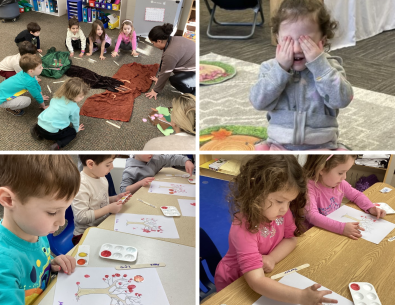
By the time students enter Shorashim (EC3-4), students gain even greater exposure to the Hebrew language. Students visit the Hebrew center each week, where our Hebrew teaching team uses music, dance, and art to introduce them to the Hebrew Alef-bet and additional vocabulary. This week, leading up to Tu B’Shevat, the Jewish New Year for trees, students learned about the different parts of the tree (of course they liked the Shorashim -- roots -- best!). They danced and used their fingerprints to personalized tree art. The variety of activities supports different learning styles and makes learning Hebrew fun, rather than a chore!
Parashat Beshallah -- דבר תורה- לפרשת בשלח
Guest writer: Rabbi Steven Chatinover
 This week’s Torah portion- Beshallah/בשלח - features the Song of the Sea/שירת הים, which the newly-freed-from-slavery Israelites sang at the shores of the Reed Sea, after witnessing Pharoah’s charioteers having been drowned in the Sea by G’s hand. Song/music is an expression of joy; a testament to the power of feelings. Is the choice of song to rejoice in this instance one to be lauded, or questioned or, perhaps, some other reaction?
According to David of Kotzk (Rabbi Dovid Morgenstern; 1809-1873; the son of, and successor to the famous Menachem Mendl of Kotzk aka the Kotzker Rebbe), the angels wanted to sing songs of praise after the Israelites were saved, but G adjured them saying, “Wait and let Israel sing first. Humans are able to praise only when they are inspired. If we do not give them the opportunity, the desire will pass”. One way of interpreting David of Kotzk’s words is that this is a moment of inspiration wherein giving thanks is surely warranted. Celebrate in song?...seems appropriate. However, this point of view is muted slightly in a famous midrash, with which I’m sure many of you are familiar, wherein G silences the angels from singing and rebukes them with the words, “How dare you sing for joy when my creatures are perishing [Babylonian Talmud, Megillah10b]”. Celebrate in song- yes; but only if you were saved.
Allow me, if you will, to bring a third source to further refine our understanding. During my first year of rabbinic studies, in Israel, Egyptian President Anwar Sadat visited Israel (I still remember seeing his limousine passing by on the street, which was festooned with alternating Israeli and Egyptian flags, in front of my apartment). As a prelude to his visit, former Israeli Prime Minister Golda Meir was interviewed on television. She was asked, “Can we ever forgive the Egyptians for killing our sons?”. Her reply has stayed with me for nearly 48 years: “We can forgive them for killing our sons. I don’t know if we can ever forgive them for making our sons kill their sons”. Being saved from death is cause enough to celebrate; to give thanks to G; to give voice to song. But overcelebrating; reveling in the suffering of those who seek to do us harm in any form, does not ennoble us. Feeling joy in the downfall of our enemies (what the Germans would call schadenfreude) does not elevate our humanity.
This coming Shabbat, as we rise and stand to hear the chanting of the Shirat HaYam, let us strive to tap into the joy which our ancestors felt at that life-saving moment; the joy of being saved from the murderous hands which sought our demise; the same sort of joy we will feel in only a few weeks’ time when we read Megillat Esther. But let that joy be somewhat circumscribed, lest we learn to revel in the loss of life necessary to save ourselves from mortal danger.



CONNECT & FOLLOW US



© Solomon Schechter Day School of Greater Hartford | Site design Knowles Kreative